Website

Click here to see my website
Edition 1 Front Cover

Click here to see my Edition 1 Front Cover
Edition 1 Contents Page
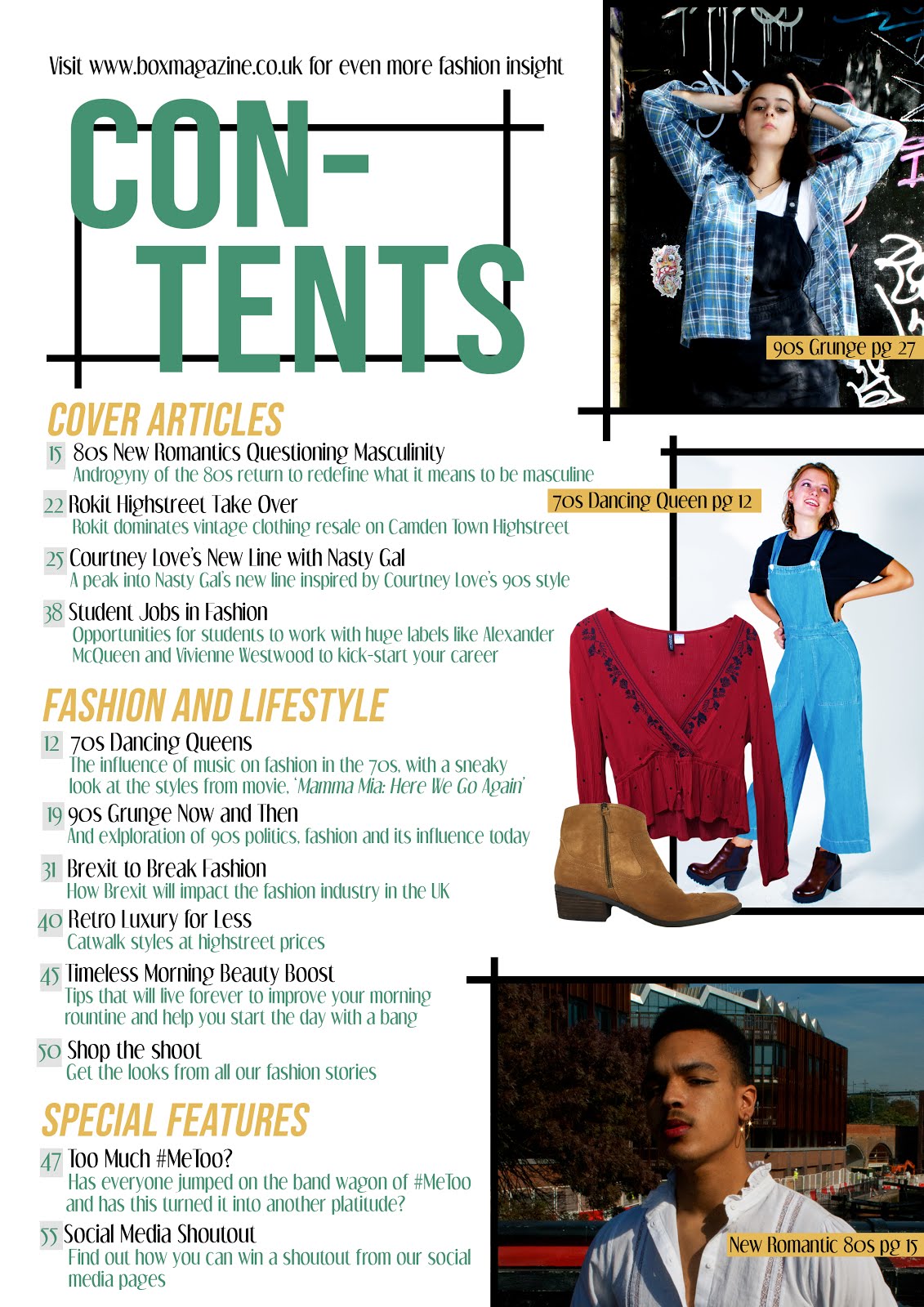
Click to see my Edition 1 Contents Page
Edition 2 Front Cover
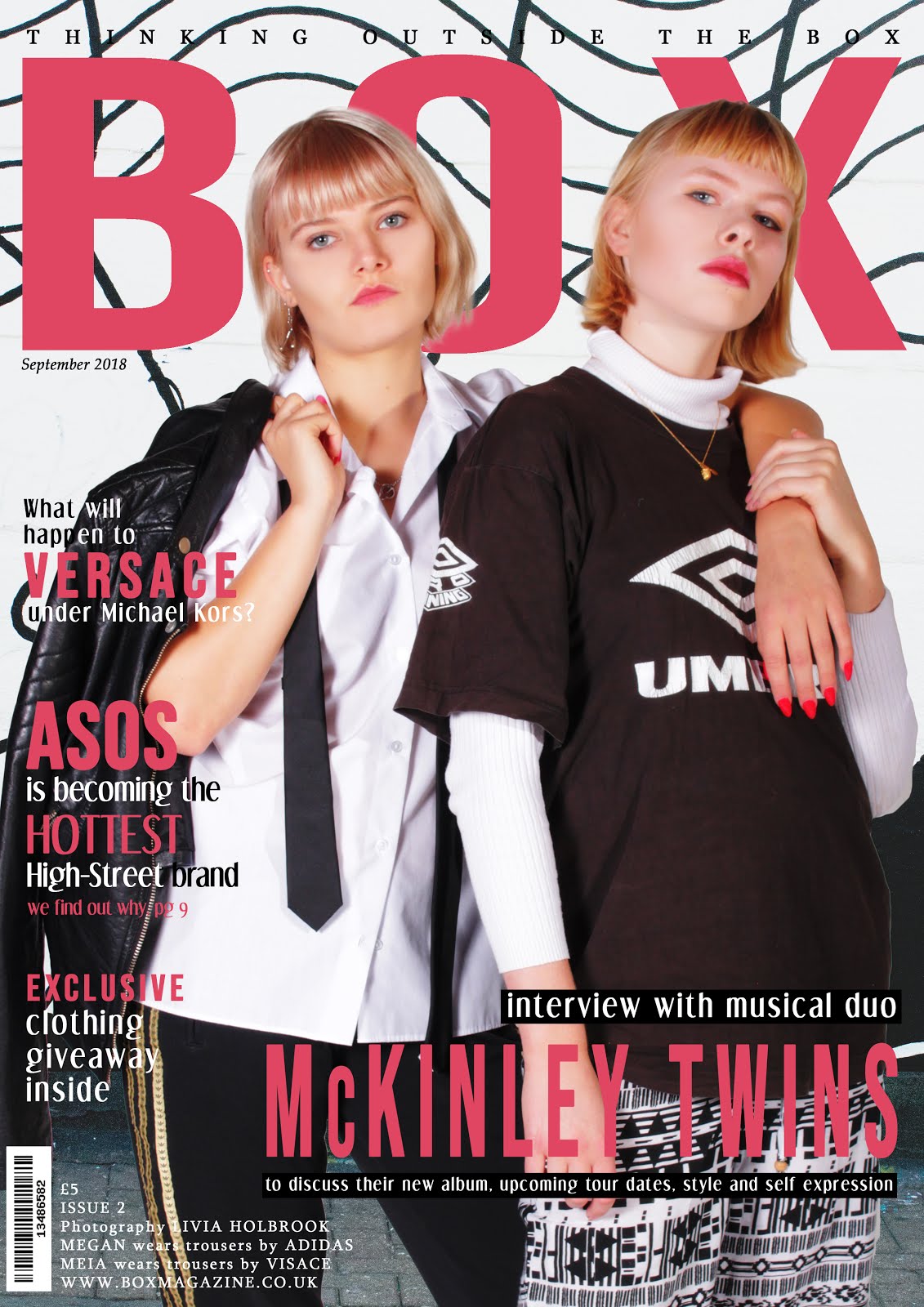
Click here to see my Edition 2 Front Cover
Edition 2 Contents Page
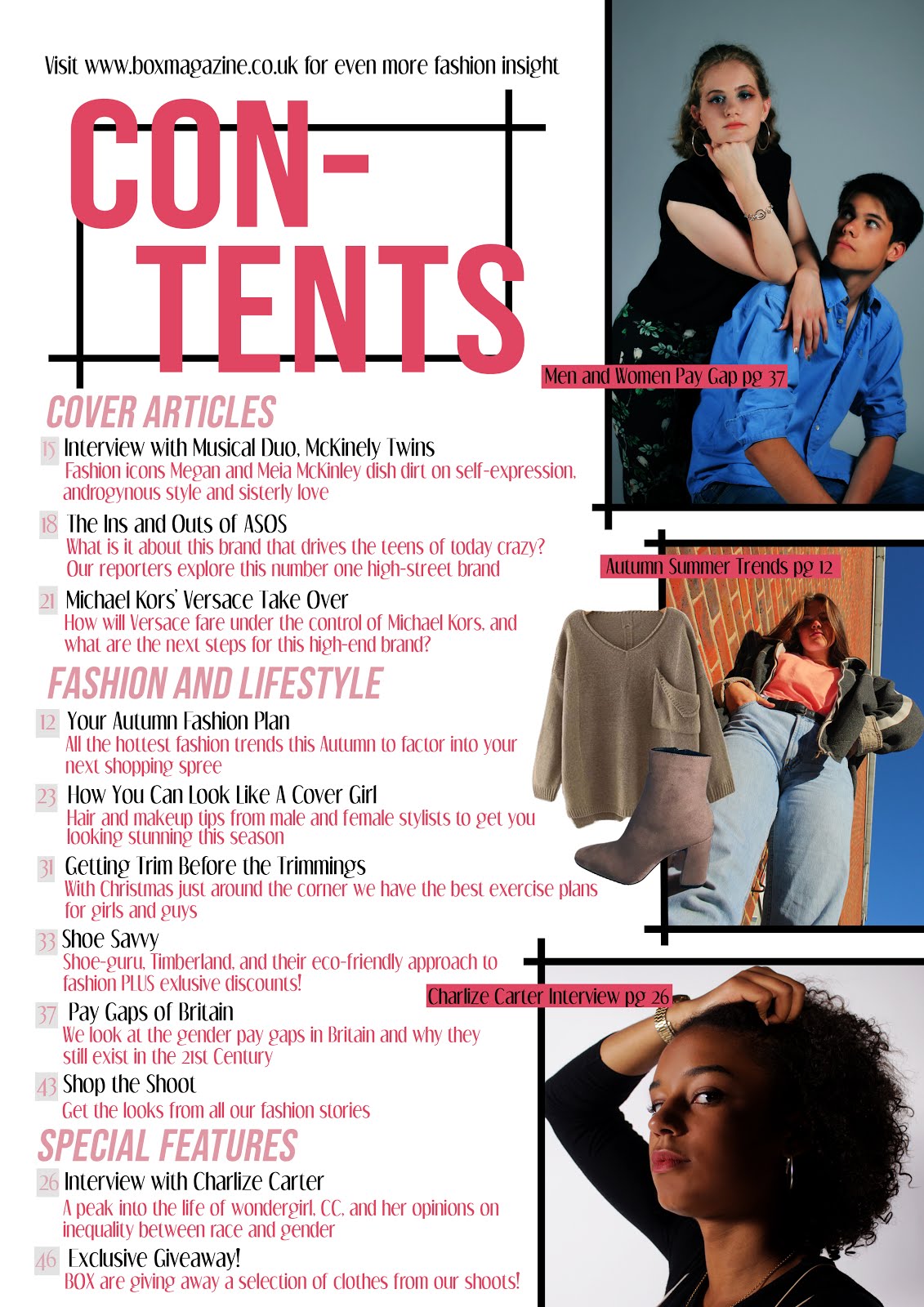
Click here to see my Edition 2 Contents Page
Showing posts with label DYM. Show all posts
Showing posts with label DYM. Show all posts
Sunday, 31 December 2017
Homeland Continuity Task
1. What was your role in the task and what did you actually do?
I was the director during the filming, and I co-planned the storyboard and shot list. I had to direct the actors and camera during the filming process, using commands such as 'camera roll', 'mark-it', 'action' and 'cut'. I then created an individual edit of the sequence.
2. What factors did you have to take into account when planning, filming and editing?
When planning our task, we focused on our brief which outlined the importance of one character entering a room whilst two others sat at a table. We used this as a starting point for our plot-line which also had to incorporate themes included in Homeland. We outlined our story arc before writing a script and making a storyboard; all of these helped us clearly know how we wanted our film to progress during planning and filming. It was also useful to have these for editing to help us edit a clear story. We created shot list so that we could easily plan which scenes to shoot first for practicality and convenience. In addition to this we drew a floor plan so we knew where we wanted furniture placed on the day of filming.
When filming I as the director had to communicate what was needed for each shot to the camera operator and actors. Through my direction I had to anticipate about how each shot would link to the next through match-on-action and continuity. We had to make sure to mark each shot with scene and take so that it would be easier to order our sequence when editing.
When editing it was important to prioritise continuity and how each shot flowed to the next to create a story through match-on-action. It was also important to make the story snappy and smooth by not have large gaps or dramatic jumps between shots.
3. How successful was your sequence? Did you manage to demonstrate match-on-action, shot-reverse-shot and the 180 degree rule? Did you achieve continuity overall?
I think that as a team we filmed a wide range of shots in an efficient way whilst maintaining the 180 degree rule and a continuous background, props and costume to provide effective continuity. This was very useful when I came to edit the sequence as there were many shots at my disposal which were all suitable for use, also including a range of techniques and perspectives which created a dynamic story. We incorporated elements of action in all our shots which made it easy to edit match-on-action effectively.
4. What have you learnt from completing this task?
From completing this task, I learnt about how to direct a filming task as well as the processes of planning which are necessary for a successful shoot. I also learnt to anticipate how shots can be cut together and what can be done pre-edit to make this task easier and more effective for a continual flow of action and continuity.

Saturday, 2 December 2017
Billboard Music Magazine Cover

1. Summarise the music celebrity you have created. Include name, music genre, personality and how they are being used to comment on contemporary celebrity.
My music celebrity is Lara Fox, a guitarist, singer-songwriter from the band Fur which create indie-rock music. Lara Fox is a feminist and believes in equality between all people. I have used this characterisation to oppose modern glamorised celebrity culture as well as the sexualisation of women in the media. She also shows that music should be the most important part of a career as a music artist.
2. Evaluate how you have constructed the representation of your celebrity through your cover image and cover headline/text (denotation/connotation of text and image).
I have used a black and white filter for the main photo to show the simplification of celebrity culture.
This is further enforced by the use of a mundane and simplistic background. I have also limited make-up and airbrushing to make the model seem more natural. The choice of outfit is very simplistic, using a baggy t-shirt instead of expensive or designer brands. This is to promote the idea of simplicity and normality of my celebrity, showing that celebrities don't have to be glamorous or seen as different from other people. The theme of valuing music is clear through the use of the guitar in the foreground, and the Green Day t-shirt. The artist's hold of the guitar also connotes intimacy between her and her music, showing its importance.
The significance of showing my celebrity's legs is to show how women's skin is not only used to imply sexual connotations. Here, bare legs show simplification but also convey how the artist is exposing herself for who she is; there are no sexual overtones of the photo. This is reinforced with the title of the article, 'don't call me foxy', which is both a play on words with her name, as well as criticising the perception of women in the media.
With the formatting of my text I have used a contrasting and striking colour to highlight the title of the magazine and article. I have also used a different font to make key details stand out.
3. Analyse how far you have used and/or challenged stereotypes of gender/race/age/sexuality in your cover.
I believe I have successfully challenged stereotypes of gender in my cover, by showing that women are not simply sexual objects. My music artist is also not a stereotypical female celebrity as she is not skinny or toned. I believe my celebrity provides a positive image for young girls. However, it does not address racial stereotypes as my celebrity is not of a minority ethnic group, and culture is not a projected theme in my cover.
4. Reflect on the production/editing process. Are you pleased with the end result? Identify what is successful about your shot? What would you have done differently in hindsight?
I was very pleased with the production and editing process of my cover. I took several shots, so I had a good range to choose from for my final cover. Because of my detailed research and the clear idea of what I wanted my cover to look like, the editing process, though complex, was quickly completed. The hardest element I found to complete was the small extract of text, as I was trying to think of the best way to present my ideas about stereotypes. In hindsight, I addressed a lot of issues in this cover, and it may have been more effective to focus of one idea and present it more prominently. Overall, I am very pleased with the way my cover turned out.
Sunday, 5 November 2017
Modern Music Video Analysis
'Colours' by Halsey (2016)
1: Motif
In the music video there is a recurring motif of blue coloured objects and materials correlating with the lyric 'everything is blue'. The repetition of this visual throughout the video draws the audience's attention to the lyrics.

2: Multiple Perspectives
Throughout the video we see the perspectives of four characters who all have interrelated story lines. The heroin is Halsey, and we know this because she is featured in the most shots and is also seen to sing the song.

3: Lips moving with song
This shots shows a typical convention of music videos with the use of an extreme close up to show the singer's lips moving to the song. In this video, this technique is used to emphasise the bridge and make the audience focus on the song lyrics. It also represents an intimate moment for the subject.

4: Beauty Shot
This shot is typically found in female artist's music videos. Here we see close-ups of Halsey wearing makeup and looking very attractive and cutesy. Here, this is emphasising how she wants to impress the guy she likes as dictated in the song.

5: Extreme Contrast in Shots
In this extract the audience sees an extreme change in shot type from a wide to a close up. This technique is often used in music videos to keep the audience engaged and entertained. It can also be used to show a deeper meaning of the song such as what the singer is really thinking about, as shown here.

Sunday, 17 September 2017
Trailer Analysis: Baby Driver
Baby Driver
Released in the UK on the 28th June 2017
Audience Appeal:
- Starts with a recognisable and upbeat song to engage the audience
- The shots are dynamic and constantly shifting the audience's viewpoint
- The action and transitions between shots are timed well with the music and give the trailer an immersive quality
- The appearance of the trailer is very aesthetic with highly saturated images to give the trailer a comic-book feel
- Features several different shots which raise many questions which keeps the audience in suspense and wanting to know more
- A comical scene is featured, amusing the audience
Genre Signifiers:
The audience assess the film to be an Action based on:
- The fast pace of the trailer
- The variation of car chases and action shots
- The use of weapons, signifying conflict and violence
- Themes of crime such as bank robbery and murder
- Romance is featured, but it clearly isn't the main focus of the movie
Character & Representation:
- The main character is Baby, portrayed by Ansel Elgort
- We can tell he is the main character because he receives the most screen time and is also the only character who is named
- It is said that he was in an accident when he was younger which is why he listens to music
- He is a driver for criminals
- He is mostly shown in sunglasses and casual clothes, presenting his as level-headed and calm
- He is a very good driver
- The audience learns very little about the other characters, but we assume that Kevin Spacey's character is important because he is the one giving orders. Because of his high reputation as an actor, we also believe he must have a leading role
Branding:
- At the beginning, logos for Sony, TriStar and MRC are shown
- These logos are featured again at the very end of the trailer along with Working Title's logo
- Instagram, Facebook and Twitter labels are shown
- The name of the film is shown after all the action
Tuesday, 12 September 2017
Reflections on Shots

1) Identify in what way this shot signifies your chosen genre? This shot features the genre conventions of a Mystery Drama. The framing of the shot is at an obscure angle and reveals little detail about the situation, however the expression and body language of my actor suggests curiosity as well as fear. Because of the lack of detail given, the audience doesn’t know what is about to happen, keeping them engaged. I also created a shadow to heighten suspense and make the scene more dramatic and atmospheric.
2) How did you direct the shot to achieve the desired effect?To achieve this effect, I took the shot from behind a white corner, contrasting with the actor’s dark clothing and the dark corridor he is in. I also used a hand-held light to create shadows around the actor, making him seem more concealed. The mise-en-scene is very generic but the framing and lighting makes it seem more intense, engaging the audience.
3) How did you intend the audience to interpret your still - what meanings did you intend to convey?
With the use of contrast in lighting I tried to show how the actor was unsure of the situation and was unaware of what was about to happen, both physically and mentally being ‘in the dark’. His facial expression shows both determination as well as uncertainty, suggesting he is the protagonist. The way in which the camera is peering around the corner matches the pose of the actor, leading the audience to sympathise with him. This shot is supposed to capture part of the intense climax before the mystery is revealed.
4) Identify what is successful about your shot The framing of the shot is successful because it fills the frame with an engaging image without being too busy. The audience’s eyes are immediately drawn to the actor and his expression
5) What would you have done differently in hindsight? In hindsight, I would make the entire still darker and less saturated to fit more effectively with the genre conventions of a Mystery Drama. I would also have made the shadow affect more prominent to reinforce the connotations that things are not as they seem and that the truth is being concealed.
Subscribe to:
Posts (Atom)